
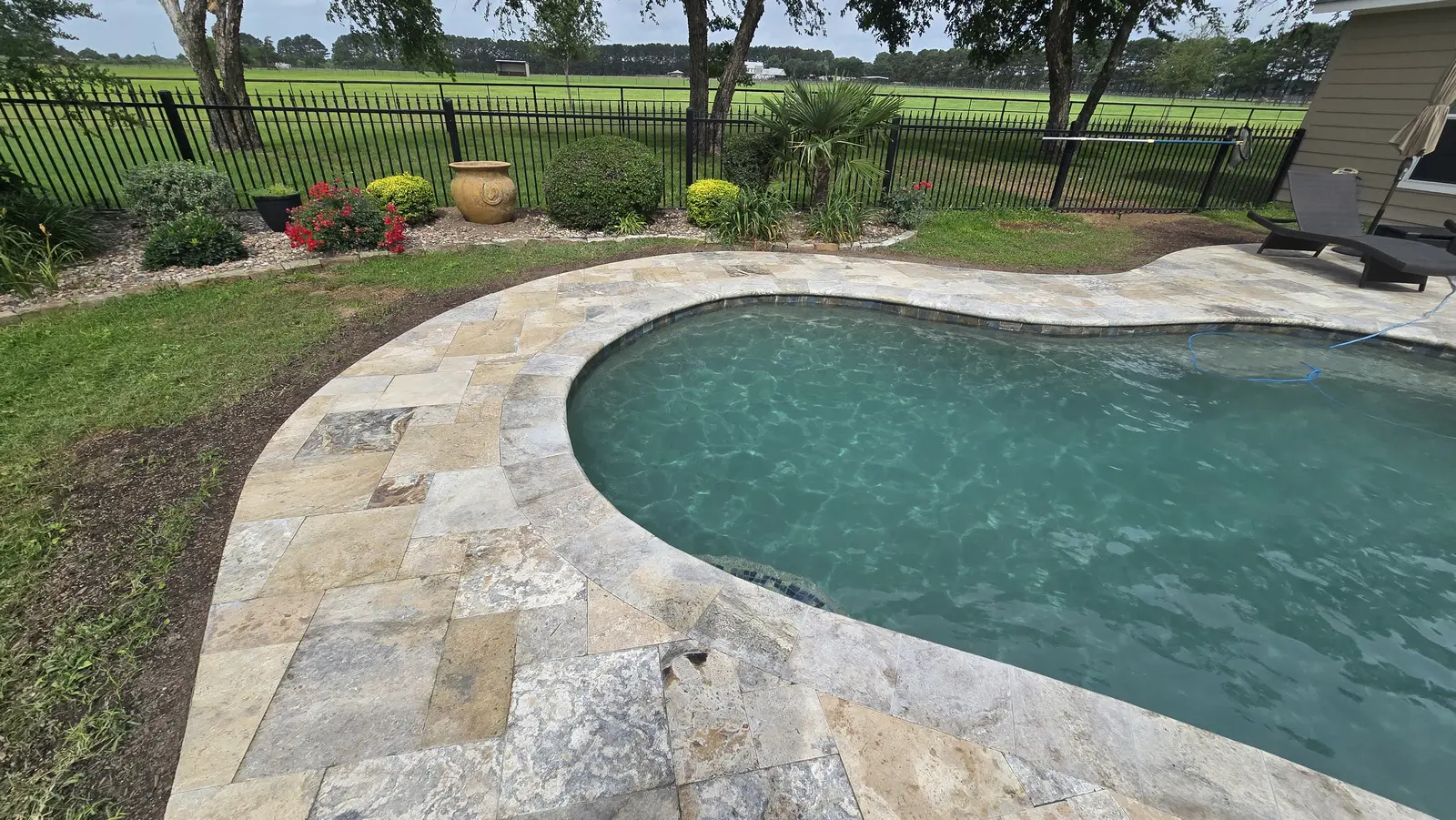
Travertine and concrete pavers can create very different pool-deck designs. Choose between actual products and a documented installation plan, rather than a promise that one material is always cooler, cheaper or easier to maintain. This guide focuses on the walking surface around the pool; the coping at the water’s edge needs its own detail.
Start with the exact product, finish and layout
Travertine is natural stone; concrete pavers are manufactured units. That distinction starts the conversation, but it does not specify a deck. Ask to see the exact product name, finish, dimensions, thickness and intended pool-deck use before comparing proposals.
The King Pools travertine decking library identifies supplier-listed nominal 3 cm pavers, with Noble Tile as the preferred provider and NPT as an approved alternate. Current inventory and the physical lot are confirmed before ordering. Concrete pavers also need a manufacturer and product selection; a broad color label is not a specification.
- Compare a representative group of samples rather than one unusually uniform piece.
- Review the proposed pattern, borders, cuts and transitions on the actual deck layout.
- Keep the approved sample and product identification with the written proposal.
Check comfort and wet-use suitability on the actual sample
For a North Texas backyard, make sun exposure, shade and barefoot use part of the selection discussion. Ask the supplier for product-specific information on exterior pool-deck use, wet conditions and any proposed sealer. Neither a photograph nor a material-family name establishes the performance of the finished surface.
Compare samples outdoors in the locations and conditions that matter to you. Review texture, edges and joints as well as appearance. Do not accept blanket claims that all travertine stays cool or that all concrete pavers are slippery. This article does not assign a temperature or slip rating to an untested product.
- Ask which finish and surface treatment the supplier evaluated.
- Include the proposed sealer in the sample review rather than adding it after selection.
- Discuss shade and circulation routes alongside the paving choice.
Compare the installation plan as carefully as the surface
Request a written cross-section or installation description for each option. It should identify the proposed support, bedding or setting system, joints, perimeter treatment and drainage approach. Have the contractor explain how the selected product works with the property and any existing slab.
For an overlay, review finished elevations at doors, steps, drains and the pool edge before approving the work. A surface replacement is also an opportunity to document existing cracks, settlement or ponding and agree on what the proposal will address. A new finish alone is not evidence that an underlying problem has been corrected.
- Identify demolition and disposal, access limits and preparation responsibilities.
- Show transitions to coping, patios, lawn edges and equipment access.
- Ask for supplier guidance on the exact product and proposed exposure, including freezing conditions.
- Do not assume ordinary paver joints make the entire deck a designed permeable pavement system.
Get a product-specific cleaning and sealing plan
The Natural Stone Institute recommends choosing cleaners to suit the stone. Acidic products can etch calcareous stone, so ask the travertine supplier for a compatible care routine. Its guidance also explains that a penetrating treatment can improve stain resistance without making stone stain-proof; some stones do not require sealing.
Concrete pavers need routine inspection too. CMHA recommends watching for displaced units, joint-material loss, damaged pavers and loose edge restraints. Concentrated pressure washing can damage a paver surface or remove joint sand. Follow the selected system’s maintenance instructions rather than treating every joint or installation the same.
Sealing guidance varies by product. CMHA describes sealing as optional for conventional concrete pavers, while individual manufacturers may recommend it for their products. Ask for written compatibility, appearance and reapplication guidance for your selection. Do not apply a conventional sand-joint maintenance routine to a permeable system without checking its requirements.
- Ask who supplies the maintenance instructions and who handles repairs.
- Review cleaning products before using acid-based stain removers or an aggressive pressure-washing method.
- Check the surface and joints periodically, especially where furniture, cooking or landscaping creates wear and staining.
Compare complete installed scope, not a price per paver
A useful comparison puts both options on the same measured layout. Ask each proposal to identify material quantities, waste allowance, preparation, setting system, drainage work, borders, steps, coping transitions, access and cleanup. Separate optional treatments and allowances from included work.
Also ask how a future repair would be made and whether spare pieces from the selected batch should be retained. CMHA notes that individual units in an interlocking paver installation can be removed and adjusted. The actual repair method still depends on how your deck is built.
There is no universal price winner in this guide. A lower material allowance does not establish a lower completed project price, and a more expensive selection does not eliminate maintenance. King Pools can review the property and requested scope before preparing a project-specific comparison.
- Use the same square footage and exclusions for both alternatives.
- Identify allowances that could change after selection or demolition.
- Record product substitutions and their effects before approving them.
Choose the deck and coping together, then record each separately
Put the shortlisted deck samples beside the coping, waterline tile and nearby house materials. Look at the combination dry and wet, while remembering that an on-screen photo cannot guarantee the installed color. Agree on the relationship between the large deck area and its borders before ordering.
Keep the pool-edge coping specification separate from the deck specification even when both use travertine. For more detail about the edge itself, see our pool coping materials comparison. For a deck selection, bring the product samples, layout and two complete scopes to a design conversation.
Common questions
Frequently asked questions
Is travertine always cooler than concrete pavers?
Do not assume that from the material name alone. Review the exact finish, color, exposure and proposed treatment, ask for product-specific evidence, and compare samples in your backyard conditions. This guide does not promise a surface temperature.
Does every travertine pool deck need sealer?
There is no single rule for every stone and application. The Natural Stone Institute notes that some stones do not require sealing and that an impregnator improves stain resistance rather than making stone stain-proof. Follow the exact supplier and treatment instructions.
Can pavers be installed over an existing concrete pool deck?
Have the contractor evaluate the existing slab and proposed system first. Review its condition, drainage, finished heights, transitions and product installation requirements. An overlay should not be assumed to correct existing movement or ponding.
How should I compare travertine and concrete paver prices?
Compare the same measured layout and complete installed scope, including preparation, drainage, joints, borders, steps, access and cleanup. Ask which items are allowances or exclusions before comparing totals.
Next step
Compare decking for your pool project
Bring your backyard photos, approximate deck layout and material shortlist. King Pools can discuss the selected products, transitions and project-specific scope before you commit to a deck.