
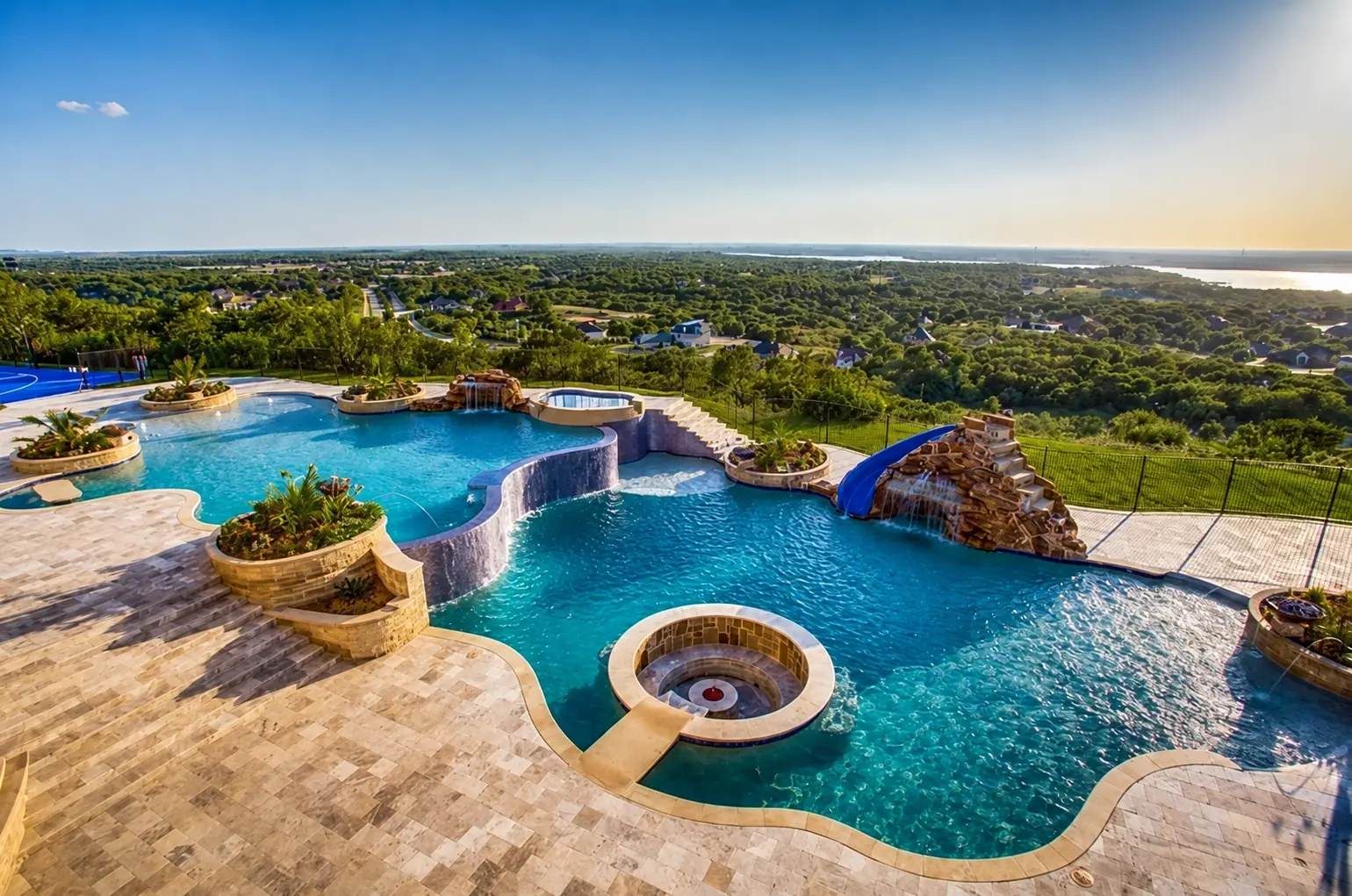
Choosing pool coping starts with more than a color. Lueders limestone, travertine and precast concrete need different product descriptions, and each choice must work with the tile, deck and pool-edge detail. Use this guide to compare specific samples and complete scopes before committing to a material.
Three material families, three different specifications
Pool coping is the edge detail around the water, and a material name alone does not describe the finished result. Lueders, travertine and precast can each belong in a pool design, but they are different material families. Compare an actual product, its profile and the proposed installation rather than ranking three broad names.
Start with these distinctions, then put the shortlisted samples beside the waterline tile and deck. A selection that looks right in a close-up photograph may read differently around an entire pool.
- Lueders: Texas limestone. The current King Pools selection lists four colors with eased or chipped edge choices.
- Travertine: natural stone that needs an exact supplier, product and profile. The King Pools coping selection is listed as nominal 3 cm.
- Precast: manufactured concrete coping. Confirm the current physical sample, available profile and color before treating a photograph as a specification.
Lueders: choose the stone color and edge treatment together
The King Pools Lueders selection identifies Buff, Cinnamon, Charcoal / Gray and Chocolate colors. These names narrow the discussion, but a name on a screen is not a promise that every piece will have an identical tone. Review a representative sample selection and talk through the amount of variation you want to see around the pool.
An eased edge and a chipped edge give the same material family different visual characters. Compare the edge from the deck and from the water side, not just the top surface. Ask which profile is included in the proposal and how corners, curves and transitions will be handled.
A useful Lueders selection records the color, edge treatment, dimensions and approved sample together. If a design also uses stone on walls or outdoor features, compare those materials at the same time rather than assuming that two similar color names will match.
Travertine: move beyond a broad color description
Travertine is another natural-stone option, but a travertine label does not identify one standardized coping product. The King Pools selection describes nominal 3 cm coping. The exact product, edge profile, dimensions and finish still need to be selected for the project.
NPT lists Ivory travertine within its hardscape collection. That is useful product-family information, not proof that every ivory travertine product from every supplier has the same appearance or dimensions. Keep the manufacturer and product identification attached to the sample you approve.
If you want travertine on both the coping and deck, ask the designer to show the relationship between those two products. Shared stone names do not establish identical thicknesses, finishes, edge details or installation requirements. The detail at the pool edge needs its own specification.
Precast: compare the profile as carefully as the color
Precast coping is manufactured concrete rather than quarried limestone or travertine. The King Pools precast selection and NPT precast collection are starting points for reviewing available shapes and colors. Confirm the current product offering and the physical sample used for your proposal.
Look at the front edge, top surface and how the shape will continue around the pool. A profile that works well on a straight run still needs an agreed treatment at corners, radius sections, steps and adjoining features. Ask what pieces and field work the quoted layout includes.
Do not treat a digital color swatch as an exact installed-color guarantee. Lighting, wetness, display settings and the surrounding tile and deck all affect what you see. Record the selected product and sample with the project documents so a later substitution can be reviewed deliberately.
Ask product-specific questions about comfort and care
There is no useful universal promise that every Lueders, travertine or precast product will stay cool, never feel slippery or need no maintenance. Evaluate the actual surface and ask the supplier for information applicable to that product and intended poolside use. A material-family name does not establish a tested slip rating or a temperature guarantee.
For natural stone, the Natural Stone Institute recommends care suited to the stone and cautions against inappropriate cleaners. Ask for the current cleaning and maintenance instructions for the exact selection. Confirm whether a treatment is recommended, which products are compatible and who will supply those instructions at handoff.
If comfort is a priority, look at representative samples in realistic outdoor conditions where practical. Use that comparison to explain your preferences to the project team, rather than turning a brief sample visit into a guarantee about every future weather condition.
Compare complete installed scopes, not a price per piece
A meaningful price comparison holds the project scope steady. Ask each option to identify the material, profile, dimensions, layout, corner or radius treatment, delivery and installation work that are included. A lower material allowance can represent a different product or a different amount of finishing work.
For a remodel, the existing coping, waterline tile and deck need to be assessed together. Ask who will evaluate the interfaces, what removal and restoration are included and which conditions cannot be confirmed until work begins. The coping choice should fit that assessment rather than drive a promise that adjacent work will never be needed.
The King Pools flagstone coping guide already explains broader sample and remodel-scope considerations. This comparison adds a different decision: identifying whether the proposed edge is Lueders limestone, a specific travertine product or a specific precast product, then documenting the details within that family.
- Exact supplier/product, color, finish, edge profile and dimensions
- Approved sample and an agreed process for reviewing substitutions
- Corners, curves, adjoining tile and deck transitions shown in the scope
- Product-specific care instructions and the actual applicable warranty documents
Bring a short, documented shortlist to the design review
Choose two or three actual samples instead of a long collection of unrelated inspiration photos. Place the samples beside your proposed tile and deck, then identify what you like about each: the color range, edge character, shape or relationship to the rest of the yard.
King Pools can discuss coping as part of a custom pool or remodeling consultation. Share your project location, photographs of existing conditions when relevant and your shortlisted materials. The next step is a project-specific selection and scope, not a universal winner among three material names.
Common questions
Frequently asked questions
Is Lueders the same material as travertine?
No. Lueders is a Texas limestone selection, while travertine is a separate natural-stone option. Specify the actual product, dimensions and edge profile rather than treating the names as interchangeable.
Is precast coping natural stone?
Precast coping is manufactured concrete. Compare the exact profile, color sample and product information with the natural-stone selections before choosing.
Which coping material is best for a pool remodel?
There is no single choice that fits every remodel. Compare actual products against the existing pool edge, waterline tile, deck interfaces, appearance preferences and complete proposed installation scope.
Next step
Compare coping for your pool project
Share your project location, existing pool photographs if applicable, and the materials you are considering so King Pools can discuss a project-specific scope.