
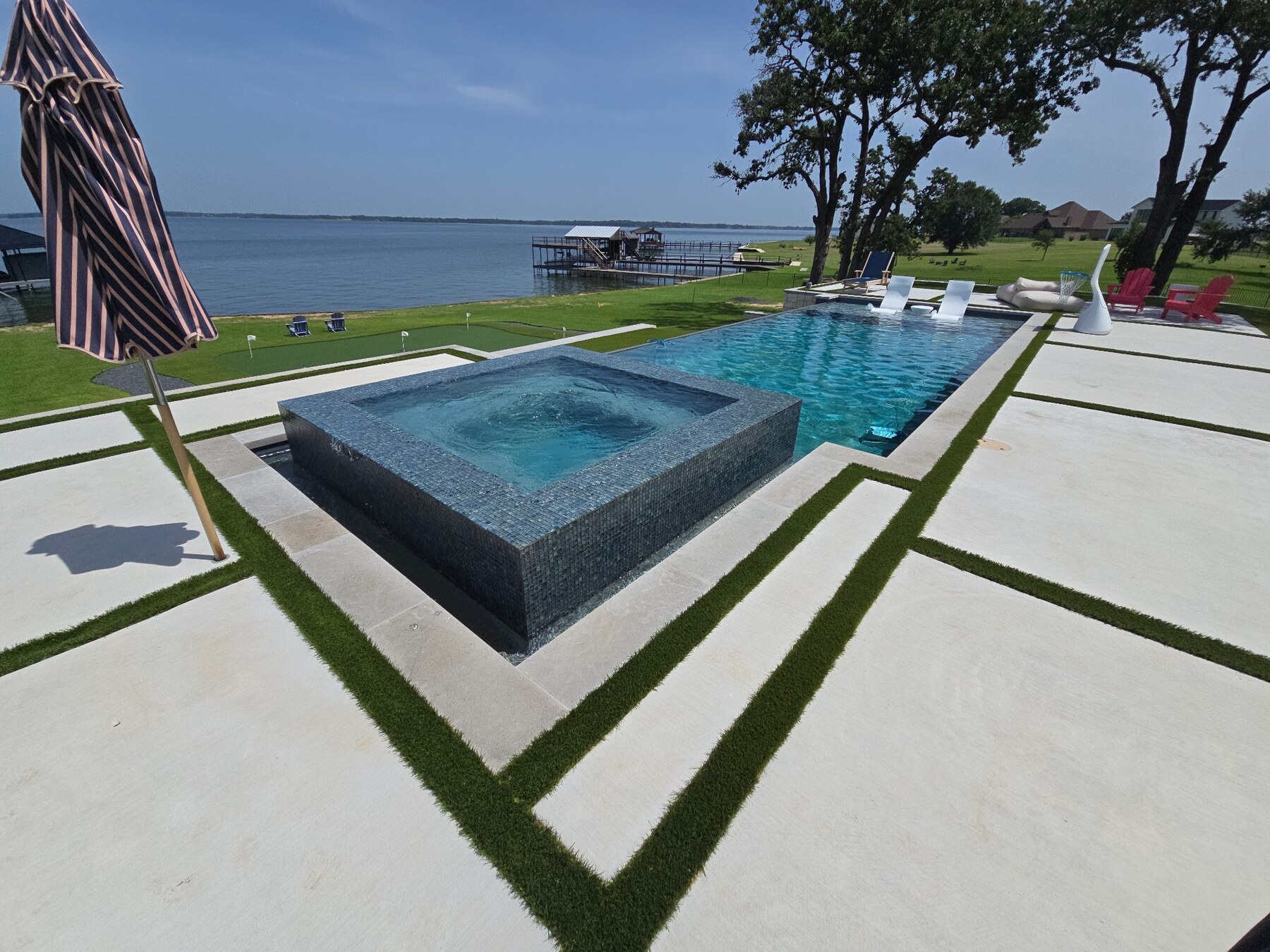
King Pools builds custom gunite pools and does not install fiberglass pools. That is a deliberate choice: gunite lets the pool be shaped around the property, the way the homeowner wants to use it, and the complete outdoor environment. Fiberglass can be a reasonable product for a buyer who prefers an available factory model, but it is not automatically cheaper—and a quick shell installation is not the same thing as a complete project.
The direct answer: King Pools recommends custom gunite
A gunite pool begins as a property-specific design and is formed, reinforced, plumbed, and built on site. A fiberglass pool begins with a finished shell manufactured in a mold, transported to the property, and placed in a prepared excavation. Both can create an enjoyable backyard, but they offer different design paths.
King Pools prefers gunite because the design is not limited to a manufacturer’s catalog shape. Length, width, depth transitions, steps, benches, tanning ledges, spas, water features, raised walls, and edge details can be coordinated as one custom plan. That flexibility matters even more on sloped lots or projects that integrate structures, kitchens, fireplaces, landscaping, and drainage.
This article is not a claim that every homeowner must choose the same system. It explains why King Pools is a gunite-only builder and what buyers should compare before accepting a broad statement that one pool type is always cheaper, faster, or longer-lasting.
- King Pools builds custom gunite pools and does not install fiberglass
- Gunite is designed and built for the property
- Fiberglass buyers select an available factory-molded shell
- Complete installed scope matters more than the shell label alone
Site-built gunite and factory-molded fiberglass are different systems
In a King Pools gunite project, the excavation follows the approved design. Steel reinforcement, plumbing, and the gunite shell are built in place, allowing the structure and interior geometry to follow the intended use and the site. Tile, coping, and the selected cementitious interior finish complete the visible pool.
A fiberglass pool shell arrives with its primary shape, dimensions, steps, benches, ledges, and depth profile already established by the mold. Manufacturers offer multiple models and sizes, so factory-built does not mean there are no choices. It does mean the homeowner is choosing among available shells rather than drawing nearly every interior line for the specific backyard.
The shell is only one part of either project. Excavation, access, drainage, plumbing, electrical work, equipment, permits, inspections, decking, barriers, grading, and restoration still have to be planned. ICC-ES AC274, for example, evaluates prefabricated fiber-reinforced plastic pool shells but expressly separates the shell criteria from electrical, plumbing, pumping, heating, and decking systems. A shell price should never be mistaken for the finished-backyard price.
Fiberglass is not automatically cheaper
Pool prices are often compared with different scopes. One proposal may include tax, decking, upgraded equipment, automation, water features, interior finishes, drainage, and site work; another may list allowances, exclusions, or items that will be priced only after excavation. A lower headline number is not necessarily a lower final project cost.
Fiberglass proposals can include costs for shell transportation, restricted access, crane or boom placement, specified backfill, groundwater control, additional concrete, and work required when the excavation or shell conditions differ from the base assumption. Gunite proposals can change with steel and shell requirements, access, soil, retaining work, finishes, and custom features. Neither system has one honest price without an address, design, and complete scope.
The responsible comparison is line by line: the proposed water shape, dimensions and depths; spa and ledges; decking quantity and material; structural and site assumptions; equipment and automation; electrical and plumbing; water features; finish quality; allowances; exclusions; tax; and who pays when an unresolved condition appears.
- Compare total installed prices, not shell prices
- Match dimensions, depths, decking quantities, equipment, and features
- Identify allowances, exclusions, and items without a final charge
- Confirm whether tax, delivery, placement, backfill, groundwater measures, and restoration are included
A documented 2025 Central Texas comparison
King Pools reviewed competing proposals for an actual 2025 Central Texas homeowner before building the project. One proposal for a 35-foot fiberglass pool totaled $87,744. The signed King Pools custom gunite contract totaled $81,657.61. On those documents, the fiberglass proposal was $6,086.39 higher.
The King Pools contract was not a stripped-down alternative. It described a custom 33-by-17.5-foot gunite pool with a tailored depth profile, three sheer descents, raised-beam and retaining treatments, a pebble-finish upgrade, automation, lighting, a cleaner, equipment, plumbing, coping, and brushed-concrete flatwork. The two proposals were not identical designs, which is precisely why the included scope must be read rather than assumed.
A second fiberglass proposal in the same comparison showed $81,022—slightly below the King Pools contract on paper—but additional concrete, boom-truck placement, and rock-related work were among the items shown as unresolved or without a final charge. It would be inaccurate to say every fiberglass quote was higher. The defensible conclusion is that fiberglass was not automatically cheaper, and an initially lower total did not necessarily represent a finished, fixed scope.
This is one project, not a universal market study or a guarantee about the next bid. King Pools is sharing the anonymized figures because they demonstrate the right way to compare proposals: use real totals, disclose meaningful differences, and account for work that has not been finally priced.
- 35-foot fiberglass proposal: $87,744
- Signed King Pools gunite contract: $81,657.61
- Difference: fiberglass was $6,086.39 higher
- Second fiberglass proposal: $81,022, with unresolved site-related costs
Gunite provides substantially more design freedom
A custom gunite pool can respond to how the homeowner wants to swim, entertain, relax, and view the yard. The shape can follow architecture, property lines, a view corridor, a patio, or a difficult grade. Depths can transition around the intended activity instead of following only a factory model’s profile.
Spas, tanning ledges, beach entries, custom steps, benches, swim-outs, water features, raised beams, vanishing details, and a negative edge can be composed as parts of one design. A compact courtyard, a traditional diving pool, and a large resort-style environment do not need to begin with the same catalog geometry.
The advantage continues outside the water. Coping, tile, stone, decking, fireplaces, kitchens, pergolas, cabanas, lighting, and landscaping can be coordinated with the pool elevations and sight lines. King Pools builds complete backyards, so the pool needs to work with the environment instead of forcing the environment to work around a delivered shell.
- Custom shape, length, width, and depth profile
- Integrated spa, tanning ledge, steps, benches, and swim-outs
- Water features, raised beams, and negative-edge details
- Coordination with patios, structures, kitchens, fireplaces, drainage, and landscaping
- Finish choices in tile, coping, stone, and interior materials
North Texas soil and site conditions still matter with either pool
Much of North Texas contains expansive soils that can change volume as moisture conditions change. A regional soil map or a neighbor’s project can provide context, but it cannot replace evaluation of the actual property, elevations, drainage, access, and construction plan. The right response is property-specific planning, not a promise that one shell material makes soil movement irrelevant.
A gunite project can be shaped and built at the site, but access, excavation, groundwater, drainage, soil, rock, slopes, and retaining conditions still affect its design and price. The construction details for one address should not be copied automatically to another.
Fiberglass also requires site planning. The selected shell must be transported into position, the excavation must receive it, and placement, bedding or backfill, drainage, groundwater, and manufacturer requirements must be handled correctly. Fiberglass manufacturers themselves publish groundwater and backfill systems because hydrostatic conditions and support around the shell are real installation considerations.
- Soil and moisture conditions
- Drainage, groundwater, slope, and retaining needs
- Construction access and protection of existing improvements
- Fiberglass delivery, crane or boom placement, bedding, and backfill
- Property-specific permits, utilities, septic systems, and inspections
A fast shell installation is not the entire project timeline
Fiberglass is often promoted for installation speed, and placing a manufactured shell can be a relatively fast phase when access, excavation, delivery, weather, groundwater, and crew scheduling all align. That can be a legitimate advantage for a homeowner whose preferred design matches an available shell.
The total project still includes design decisions, property review, permits, utility coordination, excavation, plumbing, electrical work, equipment, decking, required inspections, barriers, grading, cleanup, and startup. Patio structures, kitchens, fireplaces, and landscaping can add later phases regardless of shell type.
King Pools has completed gunite pools on accelerated schedules, but past fast projects are not a guarantee for another property. Homeowners should ask each builder for the same start and finish definitions: whether the quoted duration begins at contract, permit release, excavation, shell placement, or another milestone, and whether it ends at water fill or completion of the entire contracted backyard.
Longevity depends on the whole system, not a single sales number
Both properly designed and installed gunite and fiberglass pools can serve homeowners for decades. That statement is not a guarantee of a universal lifespan. Water chemistry, drainage, site conditions, workmanship, equipment care, finish care, use, and timely repairs all influence long-term performance.
A pool also has components with different service lives. The structural shell is not the same as the interior surface, tile, coping, decking, sealants, pumps, filters, heaters, lights, cleaners, or automation. A responsible longevity comparison separates these parts instead of assigning one number to the entire backyard.
Gunite pools use a maintained interior finish. Cementitious finishes require proper startup and ongoing water balance and may eventually be resurfaced. Fiberglass owners also have finish, water-care, equipment, decking, and site-maintenance responsibilities; a factory shell does not make the completed pool maintenance-free.
King Pools values the long-term adaptability of gunite. A well-built concrete shell provides a practical platform for later resurfacing, new tile or coping, equipment modernization, and substantial remodeling. Exact renovation options depend on the existing structure and proposed change, but a custom-built pool is not permanently tied to the original choices of a factory mold.
Who may prefer each type of pool?
Fiberglass may appeal to a homeowner who finds a factory model that fits the yard and intended use, accepts its established dimensions and depth profile, and values the possibility of a faster shell-placement phase. That buyer should still compare the complete installed scope and verify the installer’s site, backfill, drainage, electrical, plumbing, decking, and warranty responsibilities.
Gunite is the stronger fit for a homeowner who wants the pool designed around the property, wants more control over shape and depth, or expects the pool to integrate with a spa, tanning ledge, water features, a negative edge, major structures, or a complete outdoor-living plan. It is also King Pools’ preference when future finish changes and remodeling flexibility matter.
King Pools does not install fiberglass. We would rather be clear about that position than present ourselves as neutral between products we do and do not build. Our recommendation is custom gunite, supported by a complete proposal for the actual address and design.
Use one checklist to compare complete proposals
Ask each builder to price the same intended result and identify every assumption that could change. If two pools have different dimensions, depths, decking, features, finishes, equipment, warranties, or site responsibilities, the totals are not an apples-to-apples comparison.
Do not stop at the final bold number. Mark what is included, excluded, allowed for, or left open. Ask what happens if access requires larger equipment, rock is encountered, groundwater is present, more backfill or concrete is needed, a retaining condition changes, or a permit authority requires a correction.
Finally, compare the company behind the proposal: relevant experience, documented work, communication, service capacity, written warranties, insurance, payment schedule, change-order process, and who will remain responsible after startup. The best value is a complete, understandable project—not simply the first number placed on a page.
- Water dimensions, depths, steps, benches, ledges, spa, and features
- Shell, reinforcement, plumbing, electrical, equipment, and automation
- Delivery, placement, excavation, soil, rock, groundwater, drainage, and backfill
- Coping, tile, interior finish, decking quantity, and restoration
- Permits, inspections, utilities, barriers, tax, allowances, and exclusions
- Written warranty, payment schedule, change orders, startup, and post-project service
Common questions
Frequently asked questions
Are fiberglass pools always less expensive than gunite pools?
No. Fiberglass is not automatically cheaper. One documented 2025 comparison showed a $87,744 fiberglass proposal against a $81,657.61 King Pools gunite contract, while another fiberglass proposal showed $81,022 but left several site-related costs unresolved. Compare complete installed scopes for the actual property.
Why does King Pools build gunite instead of fiberglass?
King Pools chooses gunite for its custom shape and depth options, integration of spas, tanning ledges, water features and negative edges, coordination with complete outdoor-living projects, finish selection, and future remodeling flexibility. King Pools does not install fiberglass.
Can a gunite pool be any shape?
Gunite provides extensive design freedom, but every plan must still fit the property, setbacks, easements, access, elevations, drainage, structure, intended use, budget, and applicable codes. Custom does not mean those constraints disappear.
Is fiberglass faster to install?
The manufactured shell can often be placed relatively quickly when the site and schedule cooperate. The complete project still includes planning, permits, excavation, utilities, equipment, decking, inspections, barriers, grading, cleanup, and any later outdoor-living work.
Which type lasts longer?
There is no universal lifespan that applies to every installation. Both systems can serve homeowners for decades when properly designed, installed, operated, and maintained. Compare the shell, finish, equipment, decking, site conditions, workmanship, maintenance, and written warranties separately.
Does fiberglass solve North Texas soil problems?
No pool type makes soil, moisture, drainage, groundwater, access, and property conditions irrelevant. Fiberglass also requires correct placement, support or backfill, and groundwater planning. The actual address and construction plan matter.
Can a gunite pool be remodeled later?
Often, yes. Depending on the existing structure and proposed work, gunite pools can support resurfacing, tile and coping replacement, equipment upgrades, and more substantial renovations. A qualified review is needed before promising a specific structural change.
How should I compare a fiberglass quote with a King Pools proposal?
Match the intended dimensions, depths, features, decking, equipment, finishes, site work, delivery or placement costs, permits, tax, allowances, exclusions, warranties, and unresolved conditions. King Pools can then explain what its custom gunite proposal includes for the property.
Next step
Compare a custom design—not just a shell price
Share the property address, survey, intended pool use, must-have features, and any competing scope so King Pools can prepare a custom gunite design and explain the complete estimate.